ProjectDiscovery Introduces Neo Triage, Replacing Static Risk Scores with Proven Exploitability
Neo Triage reproduces every scanner, bug bounty and AI-generated finding against the real asset, then sets severity from proven impact
SAN FRANCISCO, – ProjectDiscovery, a leader in vulnerability detection and autonomous security testing, today announced the general availability of Neo Triage: a new capability in its Neo platform that validates every incoming security finding by safely reproducing it against the live asset. Every verdict comes with the exact requests and responses that prove it, so teams can go straight to fixing what’s real.
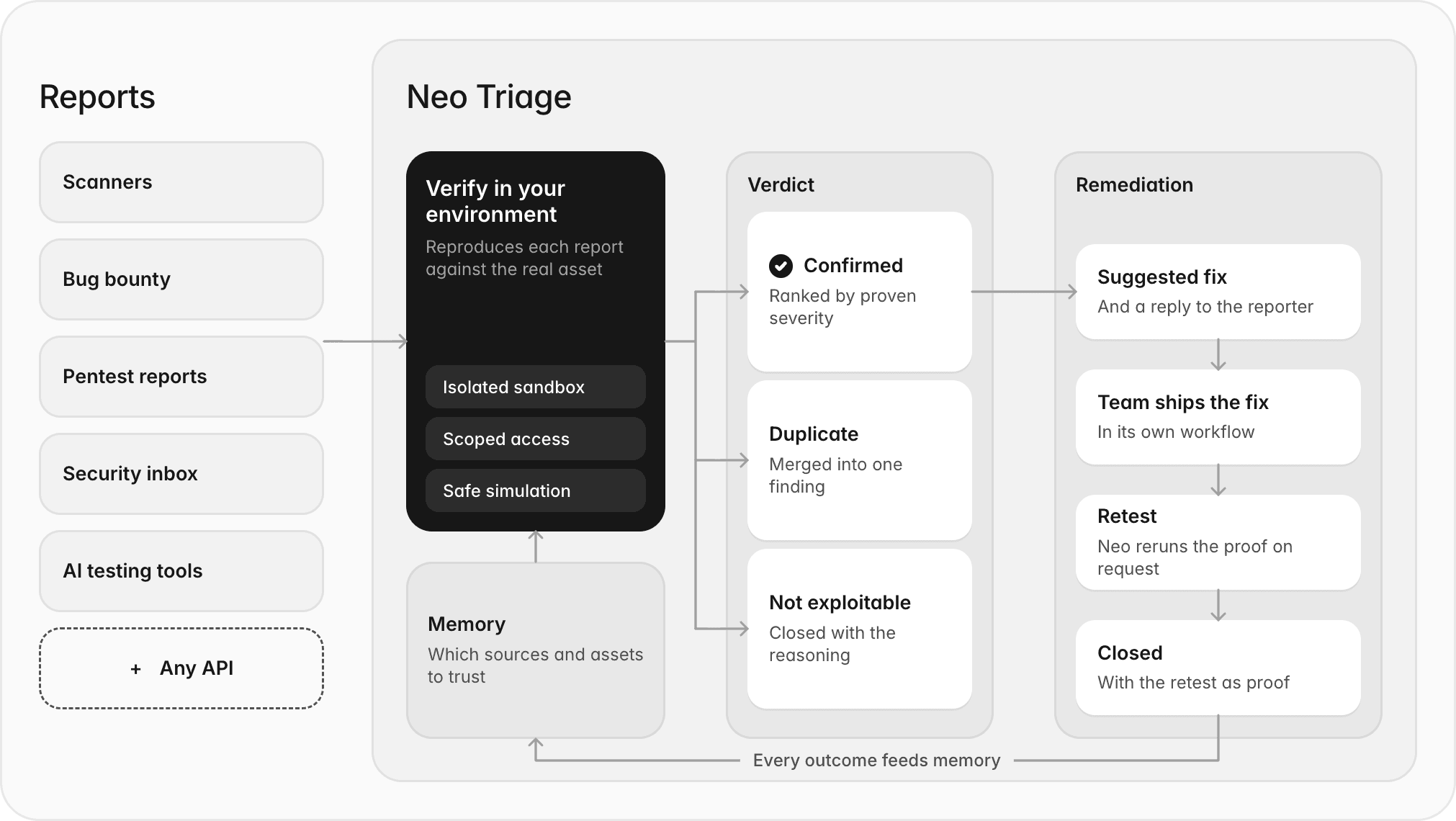
Neo Triage gives every team one place to triage findings from every source, including:
- Dynamic triage: Runs safe, non-destructive tests from an isolated sandbox to reproduce each finding against the live asset
- Verdicts with evidence: Marks every finding valid, duplicate, needs more information, informative, not applicable or spam, and attaches the exact requests and responses as proof
- Severity from proven impact: Sets severity from the impact Neo proved and from the asset's context, including the data behind it, how exposed it is and what else it reaches
- One queue for every source: Pulls findings from HackerOne, GitHub security advisories, security mailboxes, Wiz, Qualys, Orca and any other tool with an API onto one board
- Fix and retest: Suggests a fix, drafts a reply to the researcher and retests automatically once the fix ships
- Insights: Tracks open backlog, SLA status, time to zero, weekly remediation and the quality of each source
“Today, AI has made finding vulnerabilities cheap, and security teams spend hours reproducing each finding by hand. In the next 6–12 months, triage and the bottleneck it causes will be the biggest problem security teams will face. Scanners, AI code review and AI-assisted bug hunting now generate findings faster than teams can review them, leaving most organizations with thousands – or even millions – of open findings. The hard part now is deciding which findings matter, and a score can’t make that decision. Proof can. Neo Triage tests every finding against the real asset and hands the team a verdict with the evidence attached, so teams spend their time on decisions instead of on reproducing reports.”
Manual triage takes anywhere from 15 minutes to four hours per finding. ProjectDiscovery estimates that for a 100,000-finding backlog, Neo Triage turns roughly 50,000 hours of manual work, the equivalent of 25 people for a year, into about 8,300 hours of verdict review. Every Neo tier – including its free, community tier – includes the full Triage product.
Neo itself is free to get started, with monthly usage included and no time limit. Anyone can sign up and run useful workflows immediately, whether that means triaging findings from their own scanners or running a prompt that checks whether they’re exposed to a newly disclosed vulnerability. As their usage grows, teams can move to Pro or Enterprise tiers under zero data retention.
For more information on Neo Triage, visit: projectdiscovery.io/blog/introducing-neo-triage
Official Press Release
Read the full official press release for more details on Neo Triage and its capabilities.