The new bottleneck: verification
Why faster code creation pushes pressure into review, testing, governance and AppSec.
AI has flipped delivery into continuous code generation and deployment faster than teams can review line by line.
AppSec hasn’t kept up. Most programs still run scan → report → triage → debate , producing more noise, slower decisions, and risk in production. Gartner projects that by 2028, 75% of enterprise engineers will use AI code assistants, raising the bar for trustworthy verification.
This report exposes:
Why scan-and-report AST breaks down in continuously changing systems
How AI-driven delivery made verification (not detection) the new bottleneck
Where modern risk actually lives: authorization, business logic, exploit chains
If your AppSec backlog grows faster than you can validate exploitability, verification is the constraint; not scanning.
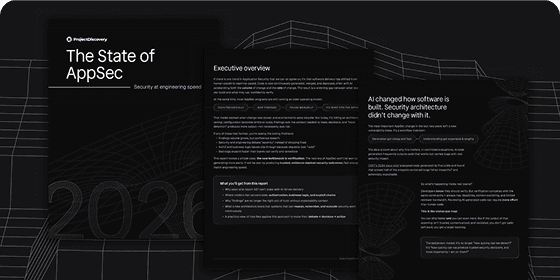
Learn why AppSec teams are hitting a hard scaling limit, how the highest-impact failures evade traditional scanning, and what “security at engineering speed” requires: trusted decisions backed by real validation and reproducible evidence.
Why faster code creation pushes pressure into review, testing, governance and AppSec.
A finding without context still requires a human to answer: is this exploitable here, right now?
Why many modern failures look like valid requests abusing unintended behavior.
How evidence-backed validation turns debates into decisions, and backlogs into action.
Continuous reasoning, memory, and execution across design → code → runtime.
What to demand: guardrails, deterministic workflows, audit logs, and strict data boundaries.
The next era of AppSec is not more alerts; it's faster, higher-confidence security outcomes.
Download the report to learn why scan-and-report hit a ceiling; and how modern teams move from findings to outcomes.
We use tools on this site to collect and record your data (e.g., your searches), which we and our vendors may use to provide, improve, and personalize our offerings, make recommendations, and for analytics and marketing. Some of these tools identify visitors and link website activity to business contact and company information so we can better understand interest in our services and tailor our outreach. We may share your data with third parties, such as advertising vendors, social media companies, and research partners, which may be "targeted advertising," "selling," or "sharing" under applicable privacy laws. Continuing to browse our site means you accept these terms and our Privacy Policy. To opt out, click the Your Privacy Choices link in the footer.