


Runs in your VPC
SaaS or VPC deployment. Customer data stays within your environment when you need it to.
Introducing Neo by ProjectDiscovery, a platform of autonomous AI agents that pentest every app, review every PR, manage your vulnerability backlog, and retest every fix.
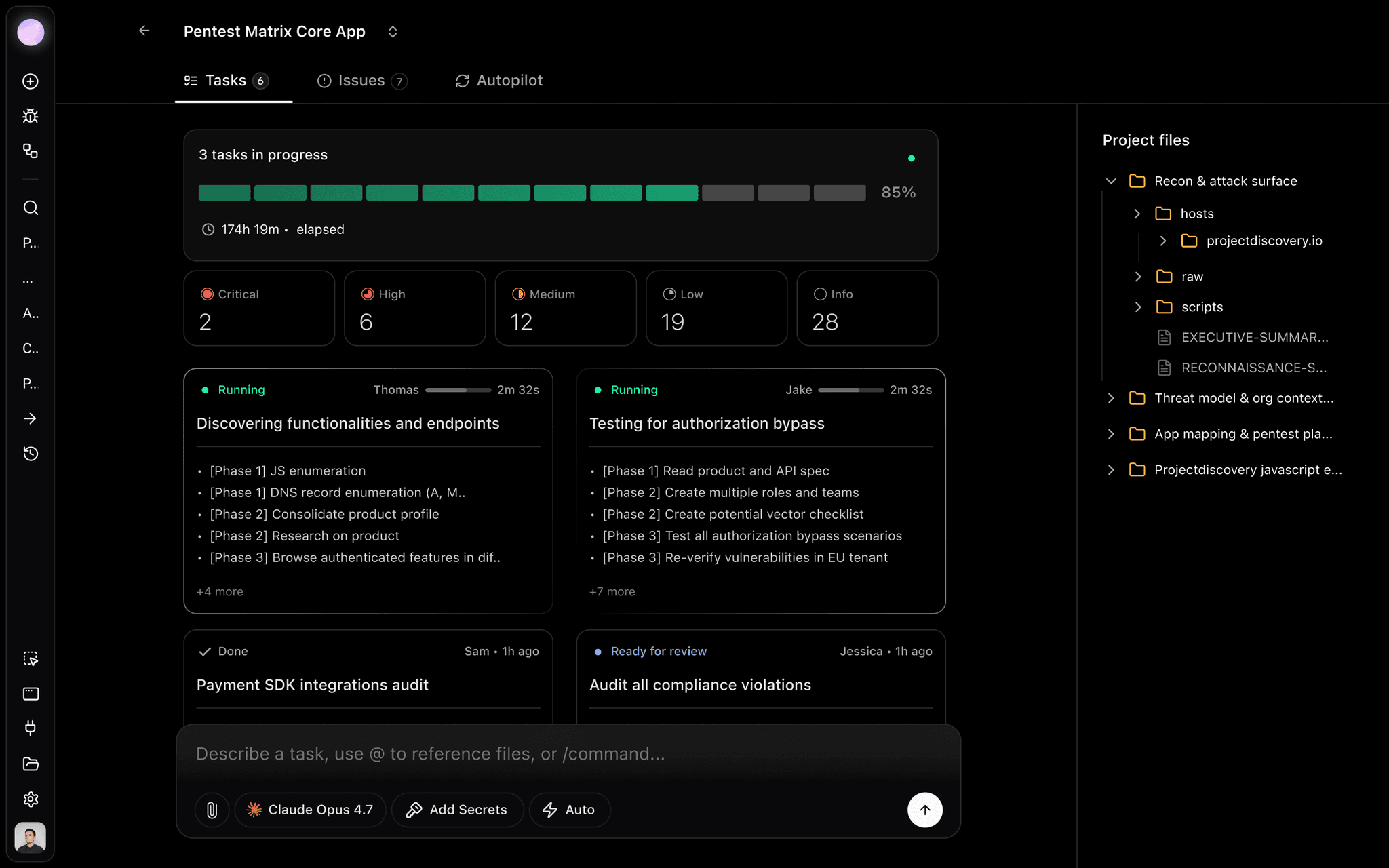
From the creators of Nuclei, Neo is purpose-built for teams that demand speed, control, and coverage at scale
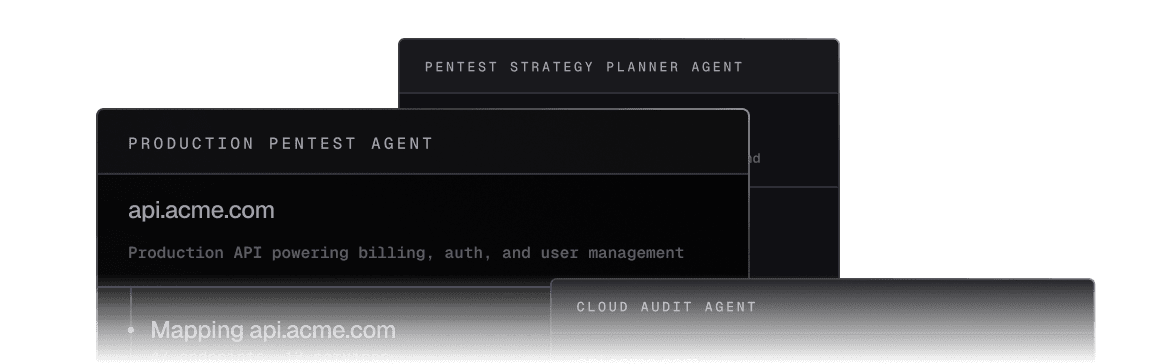
Neo continuously tests web apps, APIs, pull requests, cloud assets, and third-party integrations in one loop, tracing attack paths and proving exploitability across your environment.
Neo combines runtime validation and specialized verification tooling to cut noise, confirm real exploitability, and route high-quality critical vulnerabilities straight into remediation workflows.
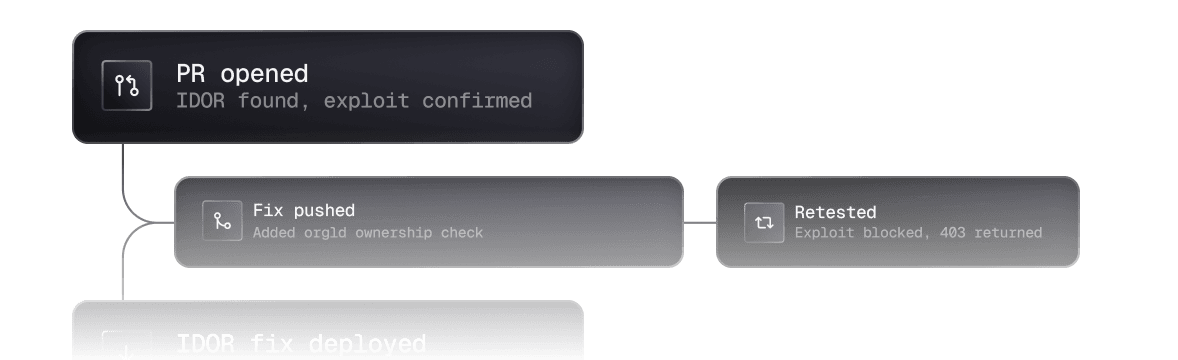
Neo triages, deduplicates, enriches severity, retests fixes the moment they ship, and catches regressions early so teams spend time remediating live risk and keeping queues current.
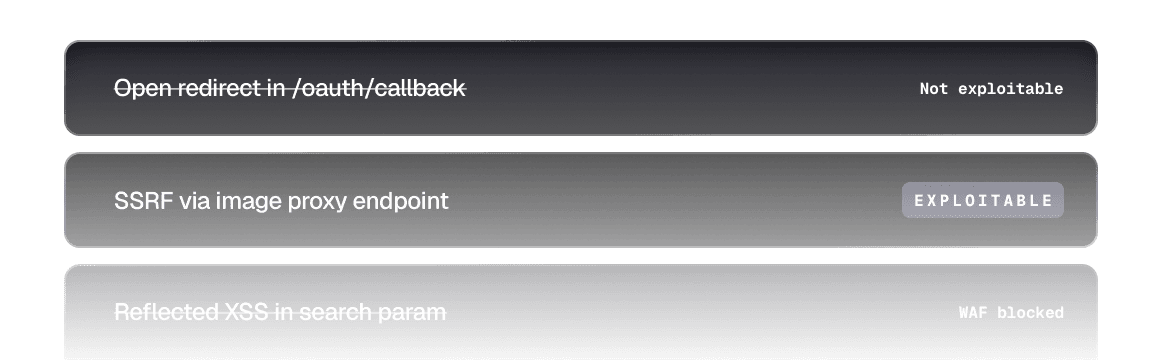
Every task runs in an isolated sandbox with privacy and security controls built in, plus rapid spin-ups that let Neo validate safely without slowing your pipeline.
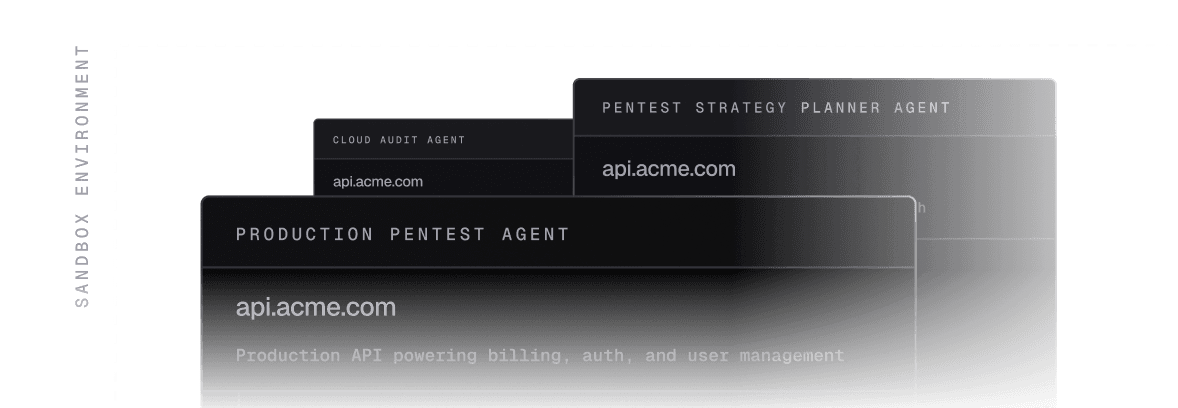
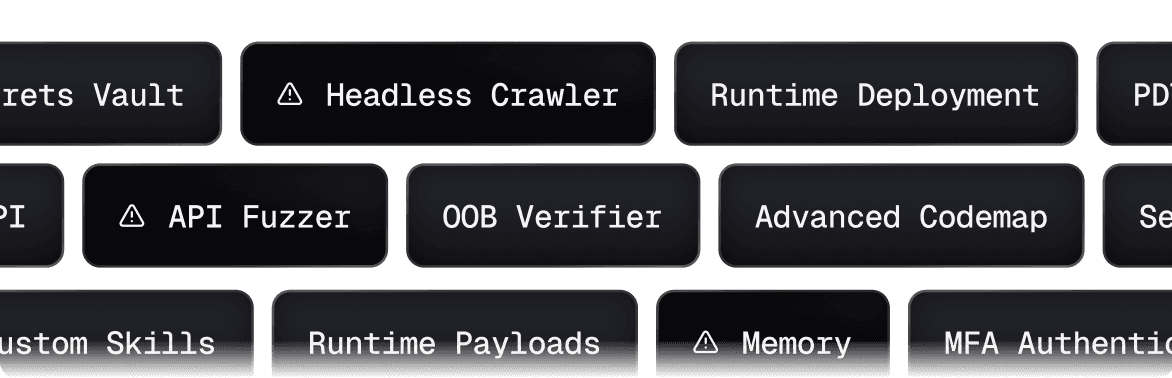
Custom parsers, fuzzers, browser proxies, crawlers, and validation layers give Neo the primitives LLMs need to operate efficiently, reliably, and repeatedly at real security scale.
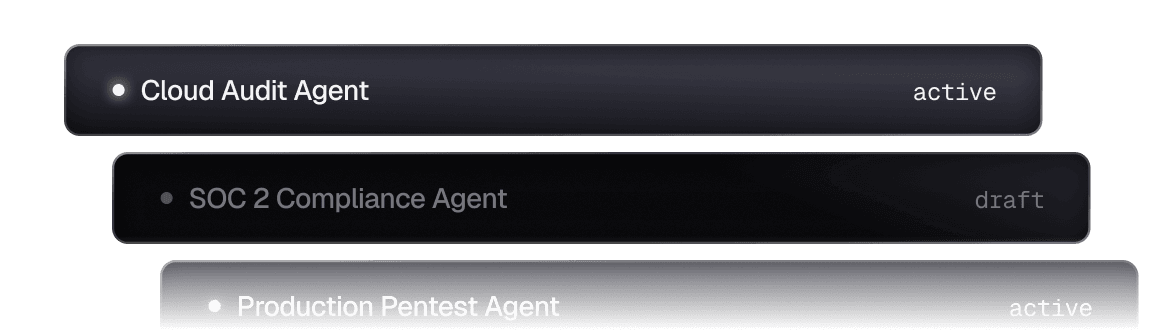
Launch hundreds of specialized agents across teams, workflows, and environments from a shared platform, with high-quality findings from the first run.
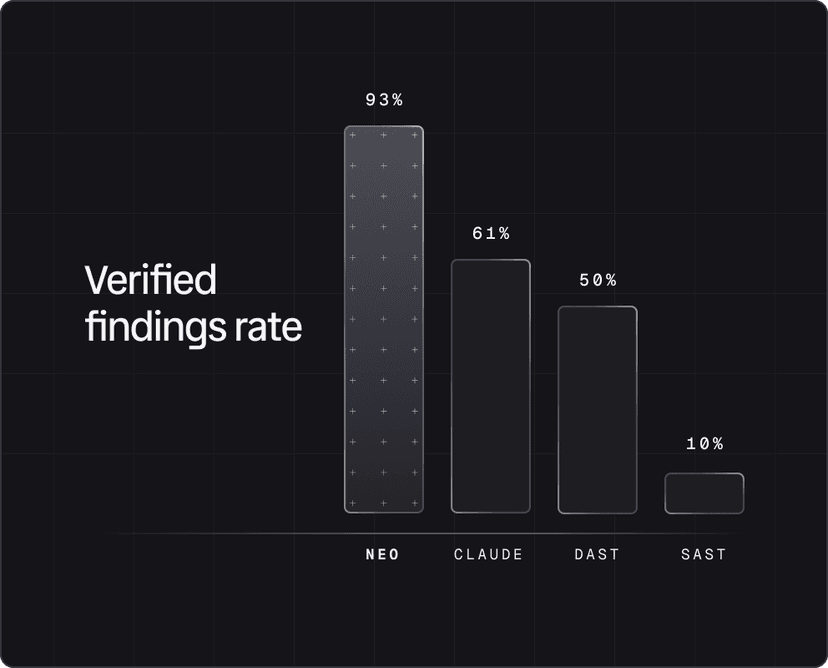
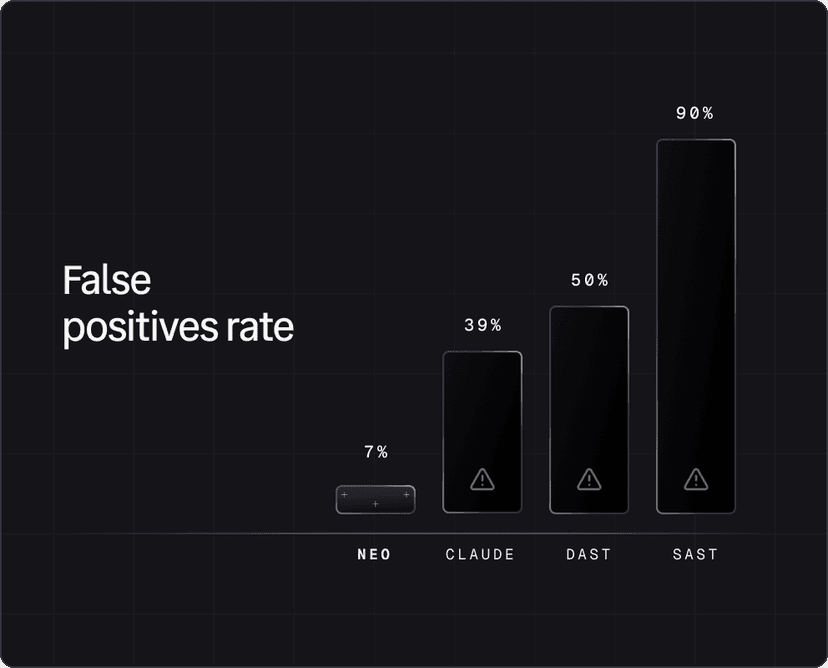
We ran a benchmark against widely used DAST scanners and AI security tools. Neo found more verified vulnerabilities with fewer false positives.
Neo chains multiple attack steps, verifies out-of-band interactions, and tests complex business logic. The classes of vulnerabilities that scanners just entirely miss.
The crawl API let users pass Python code that ran directly on the server. A broken sandbox meant anyone could execute system commands without logging in.
API endpoints accepted URLs but never checked the scheme. Passing file:// instead of https:// let attackers read any file on the server, including passwords and environment variables.
The content filter accepted XPath expressions without checking for dangerous functions. Attackers used this to read sensitive files like configs and credentials from the server.
Uploading a specially crafted content package placed executable code in a public directory. Any logged-in user could use it to run commands on the server.
The crawl API let users pass Python code that ran directly on the server. A broken sandbox meant anyone could execute system commands without logging in.
Adding a webhook-like path to the URL query string tricked the app into skipping all login and permission checks, giving full access to every API endpoint.
The status page API had no login requirement. Anyone could fetch full internal data from unpublished pages by hitting the endpoint directly.
Resource IDs were sequential and predictable, and no ownership checks were enforced. Anyone could access private content by simply guessing the next ID.
The content filter accepted XPath expressions without checking for dangerous functions. Attackers used this to read sensitive files like configs and credentials from the server.
User-supplied paths starting with // replaced the intended server host, redirecting internal API requests to attacker-controlled servers instead.
Rich text content was rendered without sanitization. Sending raw HTML through the API bypassed the editor and injected scripts that ran in every viewer's browser.
The user update API accepted any field in the request body without filtering. A regular user could add a role field and promote themselves to admin.
Configuration endpoints were accessible without any authentication, exposing database passwords, API keys, and other secrets to anyone on the network.
Process names were dropped directly into SQL queries during metric exports. A process with SQL in its name could manipulate the database and extract sensitive data.
The crawl API let users pass Python code that ran directly on the server. A broken sandbox meant anyone could execute system commands without logging in.
API endpoints accepted URLs but never checked the scheme. Passing file:// instead of https:// let attackers read any file on the server, including passwords and environment variables.
The content filter accepted XPath expressions without checking for dangerous functions. Attackers used this to read sensitive files like configs and credentials from the server.
Uploading a specially crafted content package placed executable code in a public directory. Any logged-in user could use it to run commands on the server.
The crawl API let users pass Python code that ran directly on the server. A broken sandbox meant anyone could execute system commands without logging in.
Adding a webhook-like path to the URL query string tricked the app into skipping all login and permission checks, giving full access to every API endpoint.
The status page API had no login requirement. Anyone could fetch full internal data from unpublished pages by hitting the endpoint directly.
Resource IDs were sequential and predictable, and no ownership checks were enforced. Anyone could access private content by simply guessing the next ID.
The content filter accepted XPath expressions without checking for dangerous functions. Attackers used this to read sensitive files like configs and credentials from the server.
User-supplied paths starting with // replaced the intended server host, redirecting internal API requests to attacker-controlled servers instead.
Rich text content was rendered without sanitization. Sending raw HTML through the API bypassed the editor and injected scripts that ran in every viewer's browser.
The user update API accepted any field in the request body without filtering. A regular user could add a role field and promote themselves to admin.
Configuration endpoints were accessible without any authentication, exposing database passwords, API keys, and other secrets to anyone on the network.
Process names were dropped directly into SQL queries during metric exports. A process with SQL in its name could manipulate the database and extract sensitive data.
The crawl API let users pass Python code that ran directly on the server. A broken sandbox meant anyone could execute system commands without logging in.
API endpoints accepted URLs but never checked the scheme. Passing file:// instead of https:// let attackers read any file on the server, including passwords and environment variables.
The content filter accepted XPath expressions without checking for dangerous functions. Attackers used this to read sensitive files like configs and credentials from the server.
Uploading a specially crafted content package placed executable code in a public directory. Any logged-in user could use it to run commands on the server.
The crawl API let users pass Python code that ran directly on the server. A broken sandbox meant anyone could execute system commands without logging in.
Adding a webhook-like path to the URL query string tricked the app into skipping all login and permission checks, giving full access to every API endpoint.
The status page API had no login requirement. Anyone could fetch full internal data from unpublished pages by hitting the endpoint directly.
Resource IDs were sequential and predictable, and no ownership checks were enforced. Anyone could access private content by simply guessing the next ID.
The content filter accepted XPath expressions without checking for dangerous functions. Attackers used this to read sensitive files like configs and credentials from the server.
User-supplied paths starting with // replaced the intended server host, redirecting internal API requests to attacker-controlled servers instead.
Rich text content was rendered without sanitization. Sending raw HTML through the API bypassed the editor and injected scripts that ran in every viewer's browser.
The user update API accepted any field in the request body without filtering. A regular user could add a role field and promote themselves to admin.
Configuration endpoints were accessible without any authentication, exposing database passwords, API keys, and other secrets to anyone on the network.
Process names were dropped directly into SQL queries during metric exports. A process with SQL in its name could manipulate the database and extract sensitive data.
The crawl API let users pass Python code that ran directly on the server. A broken sandbox meant anyone could execute system commands without logging in.
API endpoints accepted URLs but never checked the scheme. Passing file:// instead of https:// let attackers read any file on the server, including passwords and environment variables.
The content filter accepted XPath expressions without checking for dangerous functions. Attackers used this to read sensitive files like configs and credentials from the server.
Uploading a specially crafted content package placed executable code in a public directory. Any logged-in user could use it to run commands on the server.
The crawl API let users pass Python code that ran directly on the server. A broken sandbox meant anyone could execute system commands without logging in.
Adding a webhook-like path to the URL query string tricked the app into skipping all login and permission checks, giving full access to every API endpoint.
The status page API had no login requirement. Anyone could fetch full internal data from unpublished pages by hitting the endpoint directly.
Resource IDs were sequential and predictable, and no ownership checks were enforced. Anyone could access private content by simply guessing the next ID.
The content filter accepted XPath expressions without checking for dangerous functions. Attackers used this to read sensitive files like configs and credentials from the server.
User-supplied paths starting with // replaced the intended server host, redirecting internal API requests to attacker-controlled servers instead.
Rich text content was rendered without sanitization. Sending raw HTML through the API bypassed the editor and injected scripts that ran in every viewer's browser.
The user update API accepted any field in the request body without filtering. A regular user could add a role field and promote themselves to admin.
Configuration endpoints were accessible without any authentication, exposing database passwords, API keys, and other secrets to anyone on the network.
Process names were dropped directly into SQL queries during metric exports. A process with SQL in its name could manipulate the database and extract sensitive data.
Neo wires directly into your existing ecosystem — scanning cloud assets, validating code drops, and pushing verified fixes to your developers. It's the operating layer for continuous, autonomous security.

Neo scans your cloud infrastructure for exposures
ProjectDiscovery is powered by the world's largest open-source security community, which regularly contributes to its growing Nuclei detection library. When a critical CVE drops, ProjectDiscovery's research team works with this global community to offer you the fastest time to detection with proof.
Neo runs against your most sensitive assets. It's engineered with defense-in-depth so your security tooling meets the same standards as the environments it protects.
SaaS or VPC deployment. Customer data stays within your environment when you need it to.
Zero-retention LLM agreements. Neo never trains on your data. Configurable retention and auto-deletion.
Each task runs in an isolated environment with strict network controls. Artifacts captured, environment torn down after every run.
Scoped execution with approval gates. Agents only use secrets and endpoints you explicitly grant.
Full action logs, SAML/OIDC SSO, RBAC with custom policies. Every action traceable, every decision documented.
Every AI action is explainable, logged, and reviewable. Full visibility into what Neo tested, why, and what it found.

"Neo surfaced real race-condition and payment-bypass scenarios with step-by-step reproduction. We stopped spending days recreating timing-sensitive bugs manually."
Security Engineering Lead
Application Security Team, Fortune 500 Restaurant Chain

"We scanned 14,500 assets in under 5 minutes during a critical CVE. Validated fixes instantly with one-click retests. Our perimeter stayed audit-ready."
Clement Fouque
Principal Information Security Analyst, Elastic

"Neo validated cross-account authorization across every role with actionable PoCs. AppSec stopped being the bottleneck on PR reviews."
Senior Security Engineering Manager
Application Security Team, Top-10 Global Crypto Exchange
"Neo surfaced real race-condition and payment-bypass scenarios with step-by-step reproduction. We stopped spending days recreating timing-sensitive bugs manually."
Security Engineering Lead
Application Security Team, Fortune 500 Restaurant Chain
"We scanned 14,500 assets in under 5 minutes during a critical CVE. Validated fixes instantly with one-click retests. Our perimeter stayed audit-ready."
Clement Fouque
Principal Information Security Analyst, Elastic
"Neo validated cross-account authorization across every role with actionable PoCs. AppSec stopped being the bottleneck on PR reviews."
Senior Security Engineering Manager
Application Security Team, Top-10 Global Crypto Exchange
"Neo surfaced real race-condition and payment-bypass scenarios with step-by-step reproduction. We stopped spending days recreating timing-sensitive bugs manually."
Security Engineering Lead
Application Security Team, Fortune 500 Restaurant Chain
"We scanned 14,500 assets in under 5 minutes during a critical CVE. Validated fixes instantly with one-click retests. Our perimeter stayed audit-ready."
Clement Fouque
Principal Information Security Analyst, Elastic
"Neo validated cross-account authorization across every role with actionable PoCs. AppSec stopped being the bottleneck on PR reviews."
Senior Security Engineering Manager
Application Security Team, Top-10 Global Crypto Exchange
"Neo surfaced real race-condition and payment-bypass scenarios with step-by-step reproduction. We stopped spending days recreating timing-sensitive bugs manually."
Security Engineering Lead
Application Security Team, Fortune 500 Restaurant Chain
"We scanned 14,500 assets in under 5 minutes during a critical CVE. Validated fixes instantly with one-click retests. Our perimeter stayed audit-ready."
Clement Fouque
Principal Information Security Analyst, Elastic
"Neo validated cross-account authorization across every role with actionable PoCs. AppSec stopped being the bottleneck on PR reviews."
Senior Security Engineering Manager
Application Security Team, Top-10 Global Crypto Exchange
We use cookies and similar technologies for analytics and marketing. See our Privacy Policy.